Essay
What Would First Contact Actually Look Like in the Age of AI?
By Elijah CanfieldPublished 15 minute read
Science fiction usually gives first contact a clear beginning.
A signal arrives.
A spacecraft appears.
A message is decoded.
Humanity looks up and realizes, all at once, that we are not alone.
Reality would probably be messier.
The first credible evidence of extraterrestrial intelligence might arrive as a strange data point buried inside an enormous astronomical dataset. An artificial intelligence system might flag it before a human understands why it matters. Scientists might spend hours or days trying to prove it wrong. Screenshots could leak before verification is complete. Social media could fill with fake signals, fabricated government documents, conspiracy theories, and AI-generated videos before the scientific community even agrees that anything extraordinary has happened.
And if the evidence survives?
There is no single world authority waiting to take over.
There is no universally accepted spokesperson for Earth.
There is not even an agreed procedure for deciding whether humanity should answer.
In 2026, the International Academy of Astronautics updated the principles that guide scientists involved in the search for extraterrestrial intelligence. The new framework explicitly acknowledges a world transformed by social media, artificial intelligence, deepfakes, instant global communication, and the need for international coordination. (SETI Institute: 2026 detection and post-detection principles)
That makes an interesting thought experiment much more concrete.
What would the first 72 hours of first contact actually look like today?
The short answer: first contact would probably begin with verification, not conversation
If scientists detected a possible technosignature tomorrow, the first priority would not be sending a message back.
It would be determining whether the signal was real.
The current SETI post-detection principles call for rigorous analysis of any candidate evidence and independent verification before it is announced as a confirmed detection. Scientists would need to rule out terrestrial interference, instrument errors, satellites, natural astrophysical phenomena, software mistakes, and other explanations. (SETI Institute: Beyond Disclosure Day)
Only after credible confirmation would the problem shift from detection to something much larger:
How do eight billion people process the discovery that another technological intelligence exists?
And that may be the harder part.
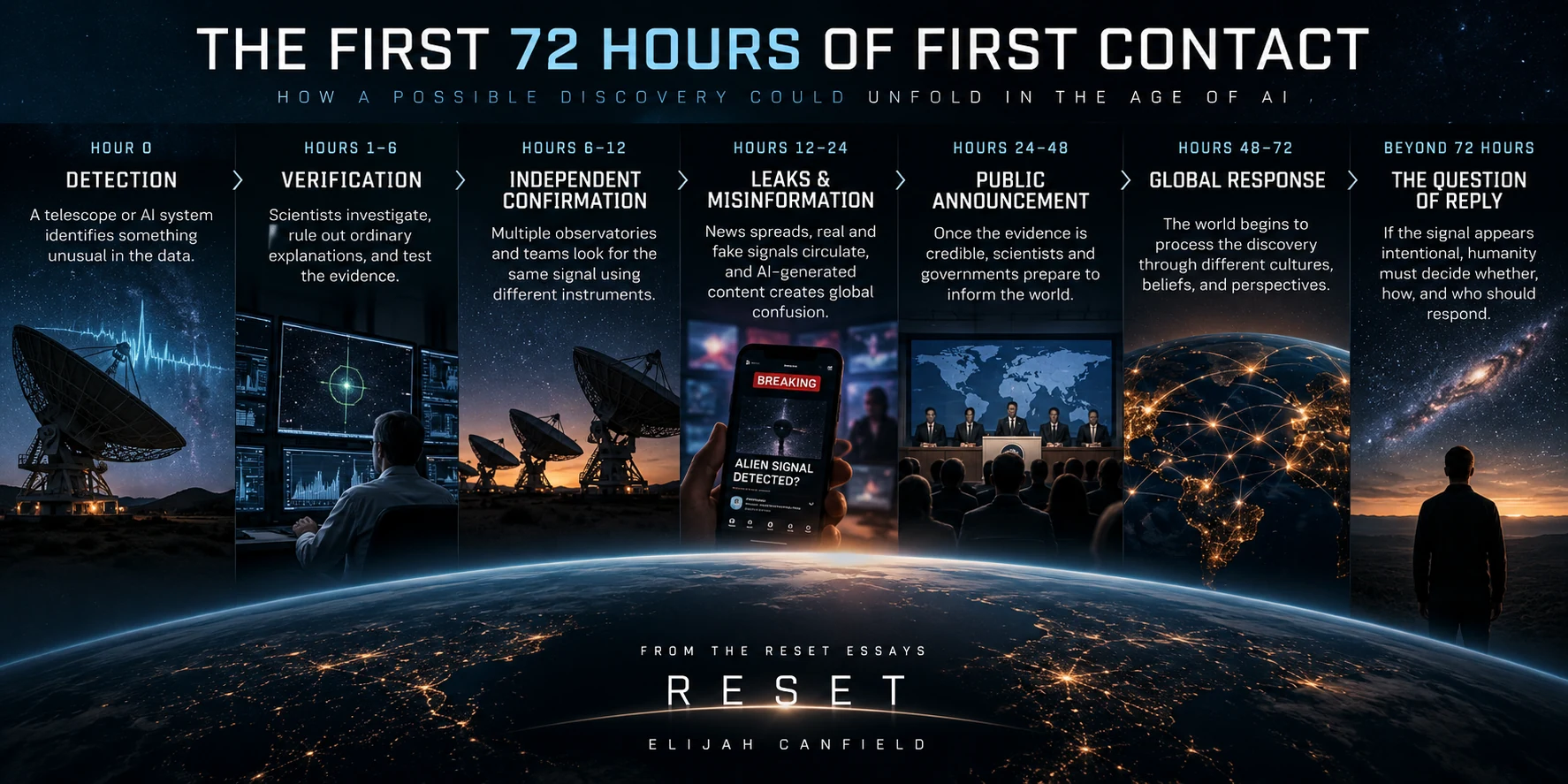
Hour 0: Something looks wrong
Imagine a radio telescope observes something unusual.
Perhaps it is an extremely narrow-band signal from the direction of a nearby star.
Or an optical telescope records a repeating laser-like pulse.
Or a machine-learning system examining a massive astronomical dataset identifies a pattern that does not resemble known natural phenomena.
None of these observations would immediately mean aliens.
Astronomy produces anomalies constantly.
Equipment fails.
Satellites interfere.
Natural objects surprise us.
Software creates artifacts.
Human technology contaminates observations.
The first reaction of serious researchers would therefore probably be skepticism.
That is not because scientists would be uninterested in extraterrestrial intelligence.
It is because the more extraordinary the possibility, the more aggressively they would want to eliminate ordinary explanations.
The most important question during the first hour might simply be:
What could make this look artificial when it isn't?
AI may notice the signal first
This is one place where modern first contact could differ significantly from the scenarios imagined a generation ago.
Artificial intelligence and machine learning are increasingly useful in searches for technosignatures because modern observatories produce more data than humans can inspect manually.
NASA describes technosignatures as possible observable evidence of extraterrestrial technology, including radio signals, laser pulses, atmospheric chemicals associated with technology, large engineered structures, and other technological traces. (NASA: technosignatures)
Whether a civilization that wanted to stay quiet could avoid producing any of them is the question behind Could Humanity Detect a Civilization Trying Not to Be Found?
AI systems can help search these enormous datasets for patterns or anomalies.
That possibility is explored more fully in an earlier essay on how AI could recognize evidence of alien intelligence before humans do.
That creates a plausible future in which the first important event in first contact is not a scientist hearing a mysterious tone.
It is an algorithm producing a very high anomaly score.
The machine might not understand what the anomaly represents.
It may simply determine that the observation does not fit the categories it has learned.
A scientist then has to decide whether that discrepancy is interesting enough to investigate.
First contact could therefore begin with a machine saying, in effect:
This does not belong.
Hours 1–6: Try to make it disappear
If the candidate were serious, scientists would probably try very hard to destroy it.
Not physically.
Scientifically.
They would ask whether the signal disappears when the telescope points away.
They would check nearby frequencies.
They would inspect raw data.
They would compare instruments.
They would check satellites and known transmitters.
They would look for software problems.
They might ask another observatory to look at the same target.
The updated 2026 SETI principles specifically emphasize independent verification and encourage cooperation among researchers before a detection is treated as credible evidence of extraterrestrial intelligence. (SETI Institute: 2026 detection and post-detection principles)
That is critical.
One telescope seeing something strange is interesting.
Several independent facilities observing the same phenomenon is fundamentally different.
The evidence becomes harder to explain away.
The most important moment may be convergence
First contact may not depend on one perfect observation.
It could emerge from several imperfect ones.
A radio telescope finds something unusual.
An optical observatory sees a correlated signal.
Another facility confirms its timing.
Archival data reveal that the phenomenon occurred before.
Independent AI systems analyzing different data begin highlighting the same target.
No single result is decisive.
Together they become difficult to dismiss.
This is the same basic reason independent replication matters throughout science.
A phenomenon that survives different instruments, different teams, different software, and different assumptions gains credibility precisely because no single failure can explain all of it.
The true discovery might therefore be less dramatic than science fiction suggests.
No alarm sounds.
No computer announces that extraterrestrial intelligence has been found.
Instead, scientists realize that every reasonable attempt to make the evidence disappear has failed.
Hour 6: Someone probably leaks it
This may be where the real 21st-century version of first contact diverges most sharply from older scenarios.
Suppose three observatories are now involved.
Dozens of researchers know something unusual is happening.
Data have been shared.
Emails and private messages are circulating.
Other telescope operators have been contacted.
Someone takes a screenshot.
Someone posts anonymously.
Someone tells a journalist.
Someone notices that multiple observatories have suddenly focused on the same star.
The updated SETI protocols recognize this new information environment directly.
The SETI Institute has said the 2026 revision was necessary partly because the previous framework was written in an era before today's social-media ecosystem and before AI-generated misinformation and deepfakes became major concerns. (SETI Institute: Humanity's Plan for First Contact)
A genuine detection could therefore become public before scientists are ready to call it genuine.
That creates an extraordinary communications problem.
The first viral alien signal might be fake
Imagine social media six hours after rumors begin.
A supposed recording appears on X.
Millions hear it.
Someone posts an image showing the alleged location.
Another account claims the Pentagon has known for years.
A video appears showing the president entering an emergency meeting.
Someone generates a convincing fake press conference.
Someone else creates an AI-generated translation of the "message."
An influencer claims the aliens sent coordinates.
Cryptocurrency markets react.
Prediction markets explode.
Religious interpretations spread.
Fake government documents circulate.
Within hours, millions of people could form strong opinions about a discovery that scientists themselves have not yet verified.
This is no longer a distant hypothetical problem.
The 2026 SETI protocol update explicitly addresses AI-generated misinformation, deepfakes, rapid media cycles, and the difficulty of communicating scientific uncertainty during a potential detection. (SETI Institute: Beyond Disclosure Day)
The first information war surrounding extraterrestrial intelligence might begin before first contact is confirmed.
Hours 6–12: Scientists face an impossible communications problem
Now imagine that researchers are increasingly convinced the evidence is real.
They face two competing responsibilities.
One is scientific caution.
The other is public transparency.
Announce too early and they risk creating global chaos over an artifact, satellite, or natural phenomenon.
Wait too long and rumors may fill the vacuum.
The updated IAA principles attempt to balance these pressures.
They allow researchers to conduct verification without an obligation to disclose those efforts immediately, but once a discovery is confirmed, the framework emphasizes timely and accurate communication with the public and scientific community. (SETI Institute: 2026 detection and post-detection principles)
That distinction matters.
There would likely be a period when scientists know something extraordinary may have happened but cannot responsibly say that extraterrestrial intelligence has been detected.
That could be the most unstable period of the entire event.
What counts as "confirmed"?
This sounds straightforward until you try to define it.
Suppose a signal has characteristics that appear artificial.
A second observatory detects it.
Then a third.
No known satellite explains it.
No terrestrial transmitter matches.
The signal repeats.
Its direction remains associated with another star.
Is that enough?
Perhaps.
But researchers would still want to understand exactly what they were claiming.
There is a large difference between:
We have detected an unexplained signal.
and:
We have detected evidence of technology.
and:
We have detected extraterrestrial intelligence.
Those statements are not interchangeable.
Science would probably move through them carefully.
Social media probably would not.
Hours 12–24: Governments enter the picture
At some point national governments would become involved.
Perhaps earlier than the public realizes.
Any credible detection of extraterrestrial intelligence would have obvious scientific significance, but it could also have national-security implications.
What is the signal?
Does it contain information?
Can it be decoded?
Is it directed at Earth?
Is it repeating?
Can anyone respond?
Do other countries possess data we do not?
Those questions would immediately involve governments, intelligence organizations, telecommunications authorities, scientific institutions, and international bodies.
Yet there is an important misconception here.
There is no global "first contact authority" with the power to take control of the situation.
The current SETI framework is a set of scientific principles and best practices, not a world government.
The 2026 declaration calls for international cooperation and consultation.
If communication with extraterrestrial intelligence were being considered after a confirmed detection, the principles say no response should be sent before appropriate international consultation, including through the United Nations and other broadly representative international bodies. (SETI Institute: 2026 detection and post-detection principles)
That is guidance.
The political reality could be far more complicated.
Who gets to speak for Earth?
This may become one of the strangest questions humanity has ever faced.
Suppose the signal clearly contains information.
Suppose we decode enough to determine that it is intentional.
Suppose, somehow, it appears to invite a response.
Who writes it?
The United States?
China?
The United Nations?
The scientists who made the discovery?
A committee?
The public?
No one?
The updated post-detection framework specifically states that scientists should cooperate with international consultations before any response is sent and that a reply should not be made pending those consultations. (SETI Institute: 2026 detection and post-detection principles)
That sounds sensible.
It does not solve the deeper problem.
Humanity has never needed to agree on what humanity wants to say.
The aliens might never know we detected them
There is another important distinction.
Detection is not necessarily communication.
Suppose we discover atmospheric chemicals on a distant planet that are extraordinarily difficult to explain without technology.
Or we observe an artificial-looking structure.
Or we detect enormous waste heat.
That would potentially tell us another civilization exists.
But the civilization might have no idea we detected it.
It might not even still exist.
The light we observe could have traveled for hundreds or thousands of years.
First contact in the cultural sense could therefore occur without any contact in the conversational sense.
Humanity could discover intelligent life and still be completely alone with the knowledge.
Detectability and contact are different problems, which is one reason the Fermi Paradox may be asking the wrong question.
A signal could take years to answer
Distance introduces another problem science fiction often removes.
Suppose we receive an intentional transmission from a civilization 500 light-years away.
The message has already traveled for 500 years.
If we answer immediately, our response will take another 500 years to arrive.
The earliest possible reply would reach Earth 1,000 years after we send our message.
That is not a conversation in the ordinary sense.
It is correspondence between civilizations.
Entire governments could rise and fall between messages.
Languages could change.
Technology could transform.
The civilization that sent the original message might no longer exist by the time we receive it.
First contact could be simultaneously the most important event in human history and something no living person would ever see completed.
What if the signal is nearby?
Now imagine the opposite.
The source is not 500 light-years away.
It is in our solar system.
Suddenly almost everything changes.
The possibility of communication becomes more immediate.
The possibility of physical presence becomes more serious.
Governments would likely react very differently.
Scientists would need to determine whether the object or signal represented a spacecraft, probe, artifact, natural phenomenon, or something else entirely.
This is why "first contact" is not one scenario.
There are many.
A signal from 5,000 light-years away.
A technosignature in an exoplanet atmosphere.
An artificial-looking object between stars.
A probe in the solar system.
A message deliberately directed at Earth.
Each would create different scientific, political, and social consequences.
Day 2: The world begins interpreting the discovery
Assume now that verification succeeds.
The evidence is extraordinary.
Multiple independent institutions agree.
There is no credible terrestrial or natural explanation.
Humanity has its first confirmed evidence of another technological intelligence.
What happens next?
Probably not one thing.
Billions of people interpret the same event through different cultures, religions, political systems, personal beliefs, and fears.
Some would celebrate.
Some would dismiss it.
Some would distrust the institutions announcing it.
Some would insist governments already knew.
Some would see confirmation of religious beliefs.
Others would see a challenge to them.
Financial markets might react.
Governments might reassure citizens.
Scientists would become instant global celebrities.
Online communities would analyze every available byte of data.
Fraudsters would appear almost immediately.
The event would not create one human response.
It would reveal how fragmented humanity already is.
AI becomes part of the discovery and part of the problem
Artificial intelligence would occupy a strange dual role.
AI systems might help discover the signal.
They might help analyze it.
They could search for mathematical structure.
They could compare possible encoding systems.
They could model interpretations.
They could analyze decades of archival observations.
They might eventually help decode information that humans alone could not process.
At the same time, generative AI would make it much harder for the public to know which recordings, documents, images, translations, and announcements were genuine.
That means AI could simultaneously improve humanity's ability to discover extraterrestrial intelligence and reduce humanity's ability to agree on what was actually discovered.
That contradiction may define first contact in our era.
Day 3: Humanity still does not have an answer
Seventy-two hours after confirmation, the biggest questions may remain unresolved.
Who are they?
How far away are they?
How old is the signal?
Was it intended for us?
Can we understand it?
Do they know Earth exists?
Should we respond?
Who decides?
What information should we send?
Should we reveal our biology?
Our location?
Our technology?
Our history?
Our conflicts?
Could a response create risk?
Could silence create risk?
The scientific question that started everything may suddenly look like the easiest one.
Is someone else out there?
Yes.
Now what?
Would governments hide the discovery?
Probably not successfully, at least not for long, if multiple civilian and international observatories independently confirmed it.
Modern astronomy is distributed.
Researchers operate across countries.
Data are shared.
Independent telescopes can verify observations.
The 2026 SETI principles explicitly encourage transparency and international scientific cooperation after confirmation. (SETI Institute: 2026 detection and post-detection principles)
A discovery made by a single classified military system might be different.
But a conventional SETI detection would be difficult for one government to control indefinitely.
The more credible the discovery became, the more people would need access to the evidence to verify it.
Scientific credibility itself would make secrecy harder.
Would there be panic?
Probably some.
But "global panic" may be too simplistic.
Human beings are remarkably capable of absorbing enormous events while continuing daily life.
People would still go to work.
Children would still attend school.
Bills would still be due.
Restaurants would still open.
Some people might spend every waking moment following the discovery.
Others might lose interest surprisingly quickly if the signal were distant and posed no immediate threat.
The emotional effect would depend enormously on what was discovered.
A distant technosignature would feel very different from an object entering the solar system.
The phrase "first contact" hides a huge range of possible realities.
The most realistic first contact might be painfully slow
The scenario I find most plausible is also one of the least cinematic.
An anomaly appears.
Scientists investigate.
More observations accumulate.
Confidence slowly increases.
Other teams reproduce the result.
A paper is prepared.
Rumors leak.
Arguments begin.
Eventually the evidence becomes strong enough that the scientific community accepts an extraordinary conclusion.
There may never be a single moment when everyone agrees that first contact has happened.
Instead, certainty spreads.
Ten scientists become convinced.
Then a hundred.
Then governments.
Then journalists.
Then much of the public.
Years later, historians debate which date should count as the moment humanity discovered it was not alone.
First contact may be a human problem more than an alien one
We tend to imagine first contact as a story about extraterrestrials.
It may actually be a story about us.
Can our institutions verify extraordinary evidence?
Can governments cooperate?
Can scientists communicate uncertainty without losing public trust?
Can people distinguish real evidence from synthetic media?
Can societies tolerate the period between suspicion and certainty?
Can humanity make a decision that no individual nation has the moral authority to make alone?
And if another intelligence asks us a question, can eight billion people agree on an answer?
Those problems exist whether the extraterrestrial civilization is hostile, friendly, indifferent, extinct, or impossibly distant.
The most immediate challenge of first contact might not be understanding them.
It might be understanding ourselves.
So what would first contact actually look like?
Probably nothing like a movie.
There may be no spacecraft over a capital city.
No president standing behind a podium saying humanity is not alone.
No instant translation.
No conversation.
The beginning could be far smaller.
A telescope records something unusual.
An AI model flags it.
A scientist checks the data.
Another observatory confirms it.
And somewhere, perhaps in a quiet control room at three in the morning, a handful of people realize that every normal explanation is disappearing.
The rest of humanity does not know yet.
For a little while, the most important fact in human history belongs to a few scientists staring at a screen.
Then someone tells the world.
And first contact truly begins.
FAQ
Frequently Asked Questions
Scientists would first attempt to verify the detection, rule out terrestrial interference and natural explanations, and seek independent confirmation. Current SETI principles call for rigorous verification before a detection is announced as confirmed evidence of extraterrestrial intelligence.
There is no single global authority designated to make such an announcement. The researchers and institutions involved would likely coordinate with other scientific organizations and relevant national and international bodies.
No. Current international SETI principles recommend that no reply be sent after a confirmed detection until broad international consultations have taken place, including through the United Nations and other representative bodies.
Yes, potentially. AI and machine-learning systems can analyze enormous astronomical datasets and identify anomalies or signal patterns that humans might not notice manually. Human scientists would still need to verify and interpret the result.
That would depend on how the discovery was made. A detection independently observed by multiple civilian and international observatories would be difficult for one government to suppress indefinitely.
Not necessarily. Detecting evidence of extraterrestrial technology could take days, months, or years to verify. If the civilization were many light-years away, meaningful two-way communication could take centuries.
No universally accepted mechanism currently gives any individual, nation, or institution the authority to speak for all humanity. Existing SETI principles call for broad international consultation before sending any response.
Sources & Further Reading
- 2026 Principles for SETI Detection and Post-DetectionInternational Academy of Astronautics / SETI Institute
- Beyond Disclosure Day: The Real-World ProtocolsSETI Institute
- Humanity's Plan for First Contact: Who Speaks for Earth?SETI Institute
- Searching for Signs of Intelligent Life: TechnosignaturesNASA
- SETI ProtocolsIAA SETI Permanent Committee
The Question Behind RESET
This is one of the questions at the heart of RESET.
Not simply:
What happens when humanity discovers another civilization?
But:
What happens during the period when only a few people understand what has been discovered?
What if artificial intelligence notices first?
What if the evidence becomes impossible to dismiss before governments, scientists, and the public are ready for it?
And what if the civilization being discovered already knows exactly what happens when younger species reach that point?
Explore First Contact Through Fiction
Read RESET: First Contact free.
Humanity’s artificial intelligence is beginning to recognize something hidden beneath the surface of reality.
The civilization watching us has survived for nearly a million years by remaining unseen.
And discovery is becoming inevitable.
Related Essays
18 minute read
Could Humanity Detect a Civilization Trying Not to Be Found?
Could an advanced civilization deliberately remain hidden from Earth? Technosignatures, directional signals, efficiency, artifacts, and AI may determine whether we could find it.
13 minute read
The Fermi Paradox May Be Asking the Wrong Question
The Fermi Paradox asks why we see no alien civilizations. But what if advanced civilizations become harder to detect as they become more successful?
12 minute read
Could AI Discover Alien Intelligence Before Humans Do?
AI is already helping scientists search for technosignatures. Could machines recognize evidence of alien intelligence before humans understand what they have found?
About the Author
Elijah Canfield
Elijah Canfield is a mechanical engineer, inventor, entrepreneur, and author of the RESET science-fiction thriller series. His writing explores artificial intelligence, first contact, hidden civilizations, technological risk, and the assumptions humanity makes about its place in the universe.