Essay
Could AI Discover Alien Intelligence Before Humans Do?
By Elijah CanfieldPublished 12 minute read
For most of human history, we have imagined first contact as a human moment.
An astronomer hears an impossible signal. A telescope captures something that should not exist. Scientists gather around a screen and slowly realize that humanity is no longer alone.
But there is another possibility.
Artificial intelligence could recognize evidence of alien intelligence before any human understands what has been found.
Not because the AI is conscious. Not because extraterrestrials choose to communicate with a machine. And not because an algorithm somehow “knows” what aliens look like.
The reason is much simpler.
We are building machines capable of searching more astronomical data, comparing more variables, and recognizing more unusual patterns than humans ever could on their own.
The first step toward first contact may therefore not be a message.
It may be an anomaly. Then another. Then another.
Until different systems begin pointing toward the same impossible conclusion.
The short answer: Could AI discover aliens before humans do?
Yes, at least in one important sense.
AI could detect a pattern, technosignature, or unexplained astronomical anomaly before human scientists recognize its significance. Researchers are already using machine learning to process enormous astronomical datasets, distinguish potentially interesting signals from interference, and identify unusual observations that conventional searches may miss.
NASA has specifically identified artificial intelligence as a promising tool for technosignature searches because algorithms can sort huge datasets for patterns that might indicate engineered signals.
That does not mean an AI has discovered extraterrestrial intelligence.
No confirmed technosignature has ever been detected.
But it raises a fascinating possibility:
The evidence could exist before we understand what the evidence means.
What is a technosignature?
Scientists searching for intelligent extraterrestrial life are not necessarily looking for aliens themselves.
They are looking for evidence of technology.
These possible signs are known as technosignatures.
A technosignature could be an unusual radio transmission, a laser pulse, artificial chemicals in another planet’s atmosphere, unusual infrared emissions, artificial illumination, or even evidence of very large engineered structures.
NASA describes technosignatures as observable signs of technology beyond Earth and notes that the search has expanded well beyond the traditional idea of simply listening for radio messages.
That distinction is important.
First contact might not begin with someone saying hello.
We could discover that another technological civilization exists without receiving a message from it at all.
And that turns first contact into a pattern-recognition problem.
Why AI could be better at finding alien intelligence
The universe is producing far more information than humans can examine individually.
Modern observatories collect enormous streams of radio observations, spectra, images, light curves, infrared measurements, and other astronomical data.
Hidden inside them are countless phenomena that must be classified or eliminated:
- instrument errors
- satellites
- human radio transmissions
- stellar activity
- pulsars
- background radiation
- statistical coincidences
- known astrophysical processes
- and phenomena scientists simply do not understand yet
Somewhere among all of that data, hypothetically, could be evidence of technology.
The challenge is finding it.
That is exactly the sort of problem where machine learning can become extraordinarily useful.
Instead of asking humans to examine every observation, AI systems can search enormous datasets and identify the tiny fraction that deserves closer inspection.
Researchers at the SETI Institute are now developing machine-learning-enabled pipelines specifically for detecting transient signals and narrowband and broadband technosignatures.
The machine does not have to solve the mystery. It only has to notice that there is one.
AI is already searching astronomical data humans cannot inspect manually
This is not merely a thought experiment.
AI is already becoming part of the infrastructure used to search astronomical datasets.
One recent system developed through work involving Breakthrough Listen, NVIDIA, and the SETI Institute demonstrated the ability to process certain radio astronomy data dramatically faster than traditional approaches while reducing false positives. The work was published in the peer-reviewed journal Astronomy & Astrophysics.
The system was demonstrated on fast radio burst detection rather than alien signals, but researchers noted an important implication: these methods may eventually help identify more complex or unexpected signal patterns relevant to technosignature searches.
And this illustrates the real advantage of AI.
It is not simply faster.
It can help scientists look for things they did not explicitly expect to find.
The biggest problem with searching for aliens: We don’t know what to look for
Every search for extraterrestrial intelligence begins with assumptions.
We assume another civilization might use radio.
We assume it might transmit lasers.
We assume industrial civilizations might alter their atmospheres.
We imagine massive energy use producing infrared waste heat.
We consider structures large enough to alter the light reaching us from distant stars.
These are reasonable scientific hypotheses.
But they are still human hypotheses.
Any extraterrestrial civilization would have developed independently from humanity.
If it were thousands, millions, or even billions of years older than us, predicting what its technology would look like becomes increasingly difficult. It is also worth asking why an advanced civilization might remain difficult to detect at all.
That creates a different way of searching.
Instead of asking:
Does this observation resemble the alien technology we imagined?
we can ask:
What in this dataset does not behave like everything else?
That is an anomaly-detection problem.
And it may be one of AI’s most important roles in the search for extraterrestrial intelligence.
AI does not need to understand what it finds
This is where the question becomes much more interesting.
Imagine an AI system analyzing astronomical observations.
It discovers something unusual.
Not dramatically unusual. Just slightly inconsistent with the models used to describe everything around it.
Then another observation arrives.
The anomaly remains.
More data arrives.
Instrumental error becomes less likely.
A known natural explanation fits poorly.
Human interference is eliminated.
A second dataset improves the confidence.
Then a third.
The system does not need to think:
I have found aliens.
It only needs to keep determining:
This explanation does not fit. And then: Neither does this one. And then: Neither does this one.
Eventually the space of plausible explanations begins to collapse.
That is what makes AI-assisted discovery so interesting.
We often imagine discovery as a moment of understanding.
But scientific discovery can also occur through elimination and convergence.
A machine may recognize that something is profoundly unusual long before a human understands why.
What if several independent AI systems find the same thing?
Now consider a more intriguing scenario.
There probably will never be one AI responsible for examining all astronomical observations.
Different observatories will operate different systems.
Universities will build their own models.
Governments, research organizations, companies, and scientific collaborations will analyze different instruments and datasets.
Those systems may use different architectures and make different assumptions.
Usually, that creates complexity.
In the search for something unprecedented, it could create confidence.
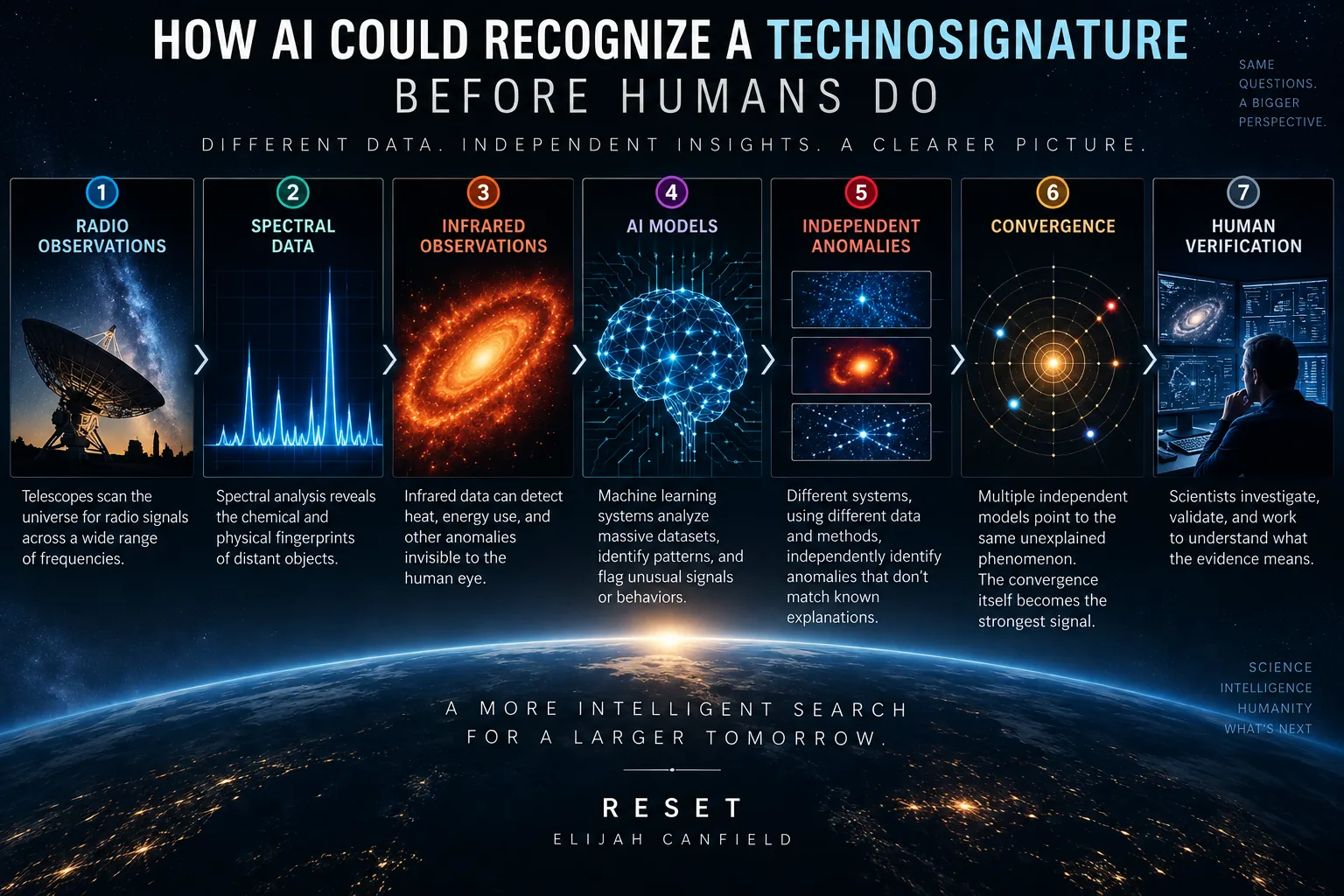
Imagine one AI analyzing radio telescope data and flagging an unusual source.
Another system studying infrared observations independently becomes interested in the same region.
A third model analyzing stellar spectra discovers something that does not fit known expectations.
A fourth system notices an unexplained timing pattern.
None of these observations proves anything independently.
None of the AI systems was instructed to find extraterrestrial intelligence.
Perhaps none even has access to the results produced by the others.
And yet they keep pointing toward the same place.
At that point, the most important observation may not be any individual anomaly.
The discovery may be the convergence itself.
Convergence could matter more than any single signal
Science becomes more convincing when independent evidence points toward the same conclusion.
That principle is especially important in SETI.
Human technology produces enormous amounts of interference. Instruments malfunction. Data contain artifacts. Statistical coincidences happen. Natural phenomena can initially appear extraordinary.
One strange observation is easy to question.
Several independent observations produced by different instruments and analyzed through different methods become harder to dismiss.
That could create an entirely new kind of first-contact scenario.
There is no unmistakable message.
No spacecraft.
No single observation that changes everything overnight.
Instead, the probability of ordinary explanations simply keeps falling.
The machines keep narrowing the possibilities.
Until eventually humanity has to confront a question it was not expecting to answer:
If every explanation we understand has been eliminated, what remains?
How AI Could Recognize a Technosignature Before Humans Do
Would the AI know it discovered aliens?
Probably not.
At least, not in the human sense of the word know.
It is important not to anthropomorphize these systems.
A machine-learning model identifying an unusual astronomical observation does not necessarily possess a belief about what caused it.
It may simply calculate that the observation does not fit established categories.
A sufficiently advanced system might conclude:
This phenomenon is inconsistent with known natural explanations.
That is very different from concluding:
An extraterrestrial civilization caused this.
The second claim requires extraordinary evidence.
And scientists working in SETI are well aware of that distinction.
What would happen after AI detected a possible technosignature?
Humans would still have to verify it.
In 2026, the International Academy of Astronautics ratified an updated Declaration of Principles Concerning the Conduct of the Search for Extraterrestrial Intelligence, its first major revision of the post-detection protocols in more than fifteen years (IAA press release).
The protocols emphasize rigorous analysis, independent verification, and careful confirmation before a potential detection of extraterrestrial intelligence is announced publicly.
That process matters because an unexplained phenomenon is not automatically extraterrestrial.
Something could remain unexplained because our astrophysical knowledge is incomplete.
The equipment could be wrong.
The model could be wrong.
The assumptions could be wrong.
AI does not eliminate those possibilities.
In fact, increasingly capable anomaly-detection systems may produce more unexplained observations, not fewer.
Most will probably have natural explanations.
Finding the rare exception would require evidence strong enough to survive every attempt to disprove it.
What if the evidence is already sitting in our data?
There is another possibility that may be even stranger.
Humanity might already possess the data containing the first evidence of extraterrestrial technology.
Astronomers maintain enormous archives of historical observations. Data collected for one scientific purpose can later be reanalyzed with techniques that did not exist when the observations were first recorded.
As machine-learning systems improve, they can return to those archives and search them differently.
That creates an unusual distinction.
There could someday be two dates associated with humanity’s discovery of extraterrestrial intelligence: the date the evidence reached Earth, and the date humanity finally became capable of recognizing it.
Those dates might be years apart.
Or decades.
First contact could already be buried somewhere in an astronomical archive, indistinguishable from noise because we have not yet learned how to ask the right question.
There is currently no evidence that this has happened.
But technologically, the possibility is no longer absurd.
Would humans trust an AI that claimed to find alien intelligence?
This may ultimately be the harder problem.
Imagine several systems begin producing increasingly unusual results.
Scientists investigate.
No obvious error appears.
New observations reproduce the anomaly.
Other researchers confirm parts of it.
Confidence rises.
At what point does somebody use the word artificial?
At what point does somebody say technology?
At what point does somebody say extraterrestrial?
And at what point does humanity believe them?
Those are different thresholds.
The updated SETI detection protocols specifically acknowledge that a modern discovery would unfold in a world of social media, rapid global communication, AI-generated misinformation, deepfakes, and intense public scrutiny (SETI Institute: Beyond Disclosure Day). Independent verification is therefore more important, not less.
That creates the possibility of a strange interval between detection and understanding.
Machines could become increasingly confident that something unprecedented exists while the humans studying their results remain deeply uncertain about what it means.
Could AI make first contact itself?
That is possible in principle, but it is a very different question.
Current SETI research is primarily about detecting possible signs of extraterrestrial technology.
Receiving information from an extraterrestrial civilization, interpreting it, deciding whether to respond, and allowing an artificial intelligence to conduct that response would introduce entirely different scientific, political, ethical, and security questions.
AI discovering evidence is therefore much easier to imagine than AI independently communicating with extraterrestrial intelligence.
The first scenario requires increasingly capable pattern recognition.
The second requires something humanity has never experienced.
So, will AI discover alien intelligence before humans do?
Perhaps.
But probably not in the way science fiction traditionally imagines.
An AI may never announce:
We are not alone.
Instead, it may identify one anomaly.
Then another.
Different models may recognize different pieces of something we do not understand.
Ordinary explanations may become progressively less convincing.
Independent systems may begin converging on the same phenomenon.
And humans may eventually realize that our machines have been pointing toward something extraordinary for longer than we knew.
That possibility changes the meaning of “discovery.”
The first intelligence on Earth to encounter evidence of another civilization might not understand what it has found.
It may simply recognize that our existing explanations are no longer sufficient.
And then humanity will have to answer the harder question.
What remains?
FAQ
Frequently Asked Questions
AI can help scientists search for possible signs of life or technology by analyzing astronomical datasets, identifying patterns, and detecting anomalies. AI has not discovered extraterrestrial life, and no confirmed extraterrestrial technosignature has been found.
A technosignature is observable evidence that could indicate technology beyond Earth. Proposed examples include unusual radio or laser signals, artificial atmospheric chemicals, artificial light, unusual infrared emissions, or large engineered structures.
Yes. Researchers are developing and using machine-learning techniques to process radio astronomy data, reject interference, identify unusual signals, detect transient phenomena, and search for potential technosignatures.
Potentially. An AI system could identify an observation as anomalous or inconsistent with known explanations without understanding that extraterrestrial technology might be responsible. Human scientists would still need to investigate and verify the evidence.
No confirmed evidence of extraterrestrial intelligence has been discovered by AI or by humans. AI-assisted searches have identified interesting astronomical signals and anomalies, but none has been verified as extraterrestrial technology.
Scientists would attempt to reproduce the observation, eliminate terrestrial interference and equipment errors, compare independent observations, and seek confirmation from other researchers or observatories before making a credible claim of extraterrestrial intelligence.
Sources & Further Reading
- Searching for Signs of Intelligent Life: TechnosignaturesNASA
- SETI Research: the search for technosignaturesSETI Institute
- Revolutionary AI System Achieves 600x Speed Breakthrough in the Search for Signals from SpaceSETI Institute (2025)
- A deployed real-time end-to-end deep learning algorithm for fast radio burst detectionAstronomy & Astrophysics, peer-reviewed paper (2025)
- Breakthrough Listen and NVIDIA: real-time AI detection of signals from spaceBreakthrough Initiatives
- Declaration of Principles Concerning the Conduct of the Search for Extraterrestrial Intelligence (2026 Update)International Academy of Astronautics
- Beyond Disclosure Day: The Real-World ProtocolsSETI Institute (2026)
The Thought Experiment Behind RESET
This question is not only scientific for me.
It became one of the ideas behind my science-fiction series, RESET.
What interested me wasn’t the familiar scenario where aliens suddenly arrive over Earth.
It was something quieter.
What if artificial intelligence began discovering evidence that humanity had missed?
What if independent systems started reaching the same impossible conclusion?
And what if whatever they were discovering had a reason it had remained hidden?
That became the beginning of a much larger story.
Explore the Thought Experiment Through Fiction
Read RESET: First Contact free.
A hidden civilization has survived by remaining unseen.
Humanity’s artificial intelligence is making that impossible.
And one observer must decide whether our species should be erased before we discover the truth.
Related Essays
13 minute read
The Fermi Paradox May Be Asking the Wrong Question
The Fermi Paradox asks why we see no alien civilizations. But what if advanced civilizations become harder to detect as they become more successful?
About the Author
Elijah Canfield
Elijah Canfield is a mechanical engineer, inventor, entrepreneur, and author of the RESET science-fiction thriller series. His writing explores artificial intelligence, first contact, hidden civilizations, technological risk, and the assumptions humanity makes about its place in the universe.
The RESET series begins with The Cost of Being Seen.