Essay
Could Humanity Detect a Civilization Trying Not to Be Found?
By Elijah CanfieldPublished 18 minute read
Imagine that somewhere in the Milky Way, a technological civilization knows that other intelligent species may exist.
It has no desire to contact them.
Perhaps it considers contact dangerous.
Perhaps it values isolation.
Perhaps it has simply survived long enough to decide that broadcasting its existence across interstellar space offers no benefit.
So it tries to remain unseen.
Could we find it anyway?
At first, the answer seems obvious.
A civilization advanced enough to travel between stars, manipulate enormous amounts of energy, or build sophisticated machines should leave evidence. Heat. Signals. Atmospheric changes. Artificial structures. Spacecraft. Something.
But that assumption becomes less secure when we look at our own civilization.
Earth is not trying to hide.
More than eight billion humans operate an industrial civilization covering an entire planet. We use satellites, radar, telecommunications networks, power grids, aircraft, rockets, and artificial illumination.
And yet from most interstellar distances, Earth would be remarkably difficult to identify as technological.
Some of our signals can travel much farther than others. Some are highly directional. Many of our most familiar technologies disappear into astronomical noise surprisingly quickly.
A civilization actively attempting to reduce those signatures could be harder to find still.
That leads to a fascinating question:
Could a civilization know we are searching for it and successfully remain hidden?
The short answer: Could an alien civilization hide from us?
Potentially, yes.
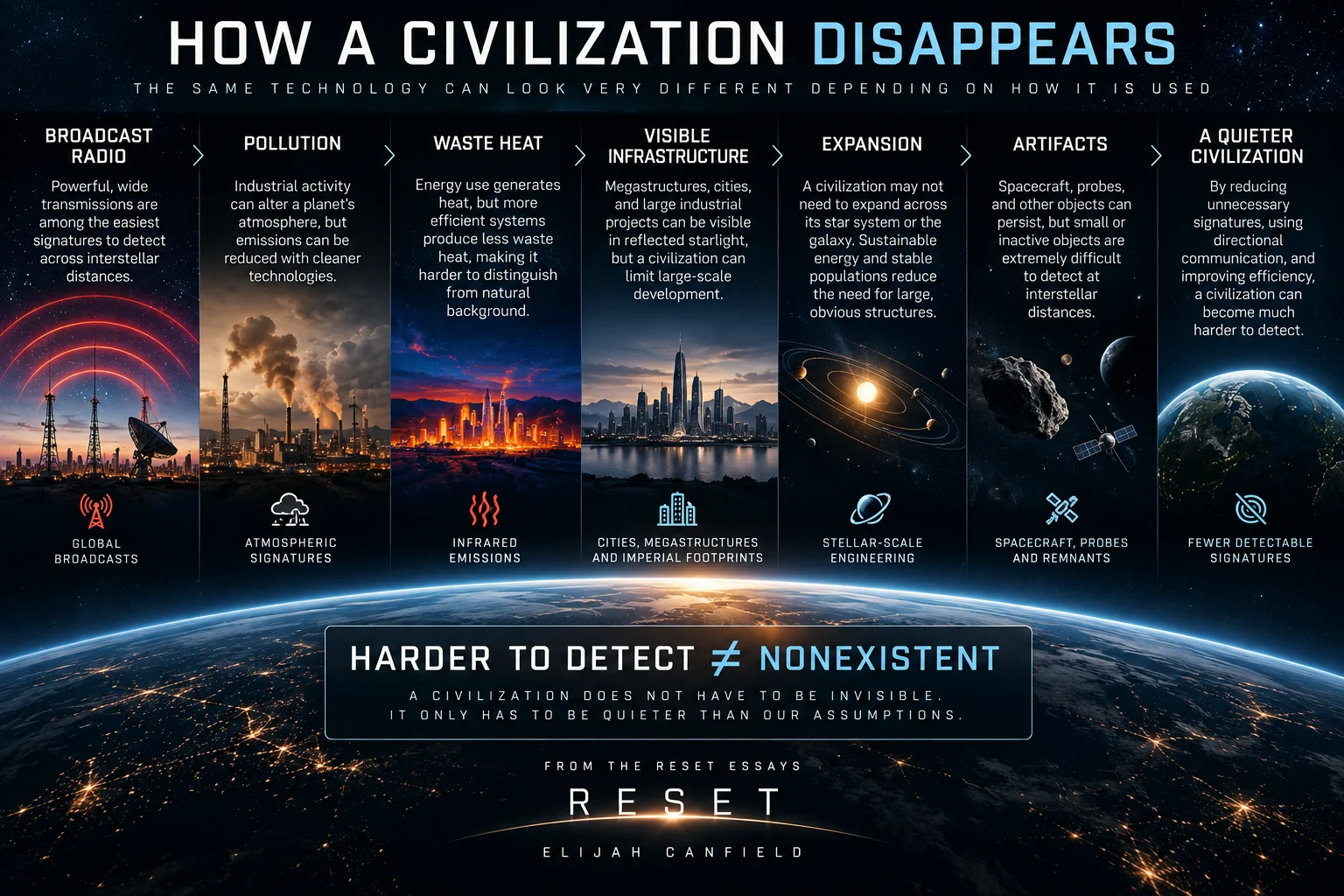
A technological civilization would not necessarily need to make itself completely invisible. It would only need to keep its detectable signals below the sensitivity of our instruments or outside the types of technosignatures we currently search for.
Research examining Earth's own technosignatures shows that different signs of our technology vary enormously in how far away they could be detected. Powerful planetary radar transmissions could theoretically be detected across thousands of light-years, while many other signatures become undetectable beyond our immediate stellar neighborhood.
Direction matters too. Some of Earth's most powerful radio emissions are not transmitted equally in every direction. An observer would need to be positioned appropriately and observing at the right time to detect them.
A civilization that deliberately reduced powerful transmissions, pollution, unnecessary energy loss, and other conspicuous signatures might therefore become extremely difficult for humanity to detect.
But difficult is not the same as invisible.
Earth gives us a useful experiment
We cannot study a real extraterrestrial civilization.
We can study ourselves.
In 2025, researchers led by SETI Institute scientist Sofia Sheikh asked a deceptively simple question:
If another civilization possessed technology comparable to ours, from how far away could it detect Earth?
Instead of examining one technosignature, the team compared many.
Radio transmissions.
Atmospheric pollution.
Optical and infrared signatures.
Satellites.
Artificial lights.
Lasers.
Heat.
Objects in space.
The result revealed something important.
Earth's technological signatures span approximately 13 orders of magnitude in detectability. (SETI Institute: Earth Detecting Earth)
That means some evidence of humanity can theoretically be detected vastly farther away than other evidence.
Our strongest planetary radar transmissions are especially visible. Researchers estimated that signals like those once produced by the Arecibo Observatory could potentially be detected from as far as roughly 12,000 light-years away with technology comparable to ours. (Sheikh et al., The Astronomical Journal)
Other signatures are far more local.
Atmospheric nitrogen dioxide, for example, would require a civilization to be only a handful of light-years away even with powerful future telescopes of the type humanity is considering.
City lights, satellites, heat islands, and similar signatures generally require an observer to be much closer still.
The implication is easy to miss.
There is no single distance at which “human civilization” becomes detectable.
There are thousands of technological activities, each producing different evidence with different visibility.
Alien civilizations would presumably be the same.
A civilization does not have to hide everything
Suppose another civilization learns that powerful radar is easy to detect across interstellar distances.
It stops using it.
Or it reduces the power.
Or it replaces broad transmissions with tightly focused beams.
That alone could eliminate one of its strongest technosignatures.
Suppose it also replaces inefficient industrial processes with cleaner technologies.
Atmospheric pollution declines.
Suppose its energy systems become more efficient.
Waste heat falls.
Suppose communication shifts from broadcast radio to fiber, lasers, narrow beams, or technologies we have not invented.
Radio leakage declines.
Suppose its population stabilizes and it sees no reason to cover planets with industrial infrastructure.
Large-scale visual signatures remain limited.
Nothing here requires invisibility.
It requires optimization.
A civilization trying not to be found might not need a cloaking device.
It may simply need good engineering.
Directional communication changes everything
One of the most important issues in technosignature detection is directionality.
Consider a lighthouse.
It may produce an extraordinarily bright beam.
But if the beam never points toward you, its brightness does not matter.
Some of Earth's strongest technological signals behave similarly.
Planetary radar systems transmit enormous amounts of power toward specific targets rather than broadcasting uniformly in every direction.
The SETI Institute notes that this geometry matters when considering Earth's detectability: an extraterrestrial observer would need to be positioned appropriately and observe during the right interval to encounter some of our strongest transmissions. (SETI Institute: how far away Earth could be detected)
That suggests an obvious strategy for a civilization concerned about being detected.
Do not broadcast.
Aim.
Two planets could exchange enormous amounts of information using tightly focused communication while allowing very little energy to escape toward unrelated star systems.
From somewhere else in the galaxy, the civilization could appear radio silent.
Its silence would not mean it lacked communication.
It would mean the communication was not intended for us.
The universe may contain conversations we are not standing inside
This creates a problem for SETI.
Imagine two inhabited systems communicating through narrow beams.
The signals cross interstellar space continuously.
Humanity could operate a perfect radio telescope nearby and detect nothing if Earth never intersects the beam.
The galaxy could contain communication networks without behaving like a radio station broadcasting equally in every direction.
This is one reason nondetection can be difficult to interpret.
A signal can exist.
A civilization can be technological.
The transmission can be powerful.
And Earth can still miss it.
We often imagine cosmic silence as though everyone has stopped talking.
It may simply mean no one is talking toward us.
A civilization might also become quieter by becoming better
There is another assumption worth examining.
Technological progress is often imagined as increasing visibility.
A young civilization consumes a certain amount of energy.
An advanced civilization consumes more.
Eventually it harnesses its planet.
Then its star.
Then perhaps many stars.
At some point, we assume, it becomes impossible to miss.
But energy consumption does not necessarily increase without limit.
NASA researchers have modeled scenarios in which a population much larger than Earth's could maintain a high standard of living using only a fraction of the stellar energy available to its planet.
The work was designed partly to investigate whether large solar arrays could serve as detectable technosignatures. Researchers found that a hypothetical civilization might have little reason to cover enormous portions of its world with solar collectors if its population and energy requirements stabilized.
NASA scientist Ravi Kopparapu connected the result directly to the Fermi Paradox: civilizations may have no need to expand across the galaxy if they can achieve sustainable population and energy use within their own systems. (NASA: why we might not spot solar panel technosignatures)
I explored that possibility at greater length in The Fermi Paradox May Be Asking the Wrong Question.
Now add deliberate concealment.
A civilization that values remaining unnoticed has an additional incentive to become efficient.
It may intentionally avoid the very behaviors our searches assume advanced civilizations will exhibit.
Waste heat seems harder to hide
There is an important counterargument.
Physics makes perfect concealment difficult.
Any civilization that uses energy eventually produces heat.
Computers generate heat.
Machines generate heat.
Habitats generate heat.
Industry generates heat.
Living organisms generate heat.
Even extremely efficient processes cannot evade thermodynamics entirely.
That is why astronomers have searched for unusual infrared emissions that might indicate enormous technological energy use.
Waste-heat searches have an advantage over searches for deliberate communication because they do not depend on an extraterrestrial civilization choosing to transmit toward us. Researchers have argued that sufficiently large technological energy supplies should create infrared consequences that could potentially be detected astronomically. (NASA: technosignatures)
So perhaps hiding has limits.
A civilization operating at truly enormous scale may find it difficult to conceal every consequence of its energy use.
But again, scale matters.
If advanced civilizations do not require star-encompassing energy consumption, their heat signatures become correspondingly harder to distinguish from natural phenomena.
A civilization cannot eliminate thermodynamics.
It may be able to remain below our detection threshold.
Hiding and being naturally difficult to detect may look identical
This creates a deeper problem.
Suppose astronomers observe a planet that appears perfectly ordinary.
No unusual radio transmissions.
No atmospheric pollution.
No artificial illumination we can detect.
No obvious excess heat.
No megastructures.
There are at least two radically different interpretations.
Interpretation one: nobody technological lives there.
Interpretation two: a civilization lives there and produces nothing our instruments can currently recognize.
Observationally, those possibilities may be indistinguishable.
Now add a third:
Interpretation three: a civilization lives there and actively wants those first two possibilities to remain indistinguishable.
How would we tell the difference?
That is the central difficulty.
Intent is much harder to detect than technology.
Searching for absence is almost impossible
If a civilization deliberately hides, we face an unusual scientific problem.
Normally, astronomers look for something.
A radio signal.
An atmospheric molecule.
An infrared excess.
An unusual light curve.
A laser pulse.
An artifact.
But deliberate concealment means looking for evidence that something has been intentionally removed.
How do you distinguish:
no radio transmissions
from
radio transmissions deliberately aimed elsewhere?
How do you distinguish:
no industrial pollution
from
advanced pollution control?
How do you distinguish:
normal planetary heat
from
technology engineered to remain within the planet's ordinary thermal profile?
How do you distinguish:
an uninhabited star system
from
an inhabited system whose machines are deliberately designed to resemble ordinary objects?
At some point, the hypothesis risks becoming unfalsifiable.
If every absence of evidence can be interpreted as proof of superior concealment, then the hypothesis stops being scientifically useful.
That boundary matters.
There is currently no evidence that extraterrestrial civilizations are deliberately hiding from humanity.
The possibility is interesting precisely because we can ask what evidence would distinguish it from ordinary nondetection.
Mistakes may be easier to detect than civilization
Perhaps we would not detect the civilization itself.
Perhaps we would detect an error.
A transmission aimed in the wrong direction.
A spacecraft maneuver.
A temporary industrial event.
An unexpected atmospheric chemical.
A brief laser pulse.
A failed attempt to conceal waste heat.
A probe passing through the wrong place.
A technological civilization lasting a million years would have an enormous amount of time in which something could go wrong.
Perfect secrecy would need to survive not one moment, but perhaps millions of years.
That may be a much more difficult engineering problem.
A civilization can control its intentional transmissions.
It cannot necessarily guarantee that every artifact, accident, discarded machine, historical layer, and ancient technological remnant disappears forever.
Archaeology may beat eavesdropping
That suggests another possibility.
The best evidence of a hidden civilization might not be something it is doing now.
It might be something it did long ago.
Technological artifacts can potentially outlast the behavior that created them.
A probe.
An abandoned structure.
Modified planetary material.
Artificial objects on airless worlds.
Microscopic engineered particles.
In September 2026, researchers associated with the SETI Institute proposed searching lunar soil for microscopic technosignatures: engineered particles that could, in principle, have traveled through interstellar space and become preserved on the Moon. (SETI Institute: searching the Moon for microscopic technosignatures)
The researchers did not report evidence of extraterrestrial technology. Instead, they developed a quantitative framework showing that the idea can be scientifically tested using lunar geology, models of interstellar particle transport, and modern analytical tools.
The proposal illustrates an important principle.
A civilization could stop transmitting.
It could disappear.
It could deliberately become quiet.
But matter can remember.
The Moon may contain a better archive than Earth
Earth is a terrible archaeological archive on billion-year timescales.
Weather erodes.
Plate tectonics recycles the crust.
Life transforms material.
Oceans move sediments.
Impacts and geological processes repeatedly alter the surface.
The Moon is different.
Its surface can preserve material for extraordinary lengths of time.
That is why lunar searches for unusual particles or artifacts are conceptually interesting.
A civilization trying to remain hidden today could theoretically leave evidence from a much earlier era somewhere it no longer controls.
This expands SETI beyond listening.
We are not necessarily searching only for civilizations actively communicating now.
We can search for technological history.
Artificial objects may be easier to hide until they are close
Imagine a small autonomous probe traveling between stars.
At interstellar distances it may be almost impossible to detect.
It produces little light.
It broadcasts nothing.
It generates minimal heat.
Against the darkness of space, it might escape every telescope we operate.
But once it enters a planetary system, the situation changes.
Its motion may not match ordinary celestial mechanics.
It may maneuver.
It may emit energy.
It may interact with matter.
It may become observable because its behavior distinguishes it from natural objects.
Again, detection may depend less on what something is than on what it does.
That is why anomaly detection could become increasingly important.
AI could change the hiding problem
Humanity now possesses an observational problem larger than any group of scientists can manually solve.
Telescopes collect immense quantities of data.
Most observations are ordinary.
Some contain known anomalies.
A much smaller number may contain patterns nobody thought to search for.
Machine learning can help examine those datasets at enormous scale.
In 2025, researchers working with the SETI Institute and Breakthrough Listen demonstrated a system capable of processing certain radio astronomy data roughly 600 times faster than previous approaches while improving identification of complex signal patterns. The system was demonstrated on fast radio bursts, not extraterrestrial transmissions, but the techniques could also improve searches for unexpected technosignatures. (SETI Institute: AI system for radio signal detection)
This changes the equation.
A hidden civilization may avoid the signatures we deliberately search for.
It cannot necessarily anticipate every correlation future machines will discover in data we already possess.
That is the same possibility behind an earlier RESET essay, Could AI Discover Alien Intelligence Before Humans Do?
Hiding from humans is different from hiding from machines
Humans design searches around ideas.
We decide what alien technology might look like.
Then we build instruments and algorithms to look for it.
Artificial intelligence allows a different strategy.
Instead of only asking:
Does this look like the technology we predicted?
we can increasingly ask:
What here behaves differently from everything else?
That distinction becomes especially important when searching for something attempting to blend in.
A deliberately hidden technological phenomenon might resemble natural background extremely well.
But perfect imitation is demanding.
Perhaps one wavelength looks right but another does not.
Perhaps the thermal behavior is slightly wrong.
Perhaps orbital dynamics require an unexplained correction.
Perhaps several independent datasets reveal tiny inconsistencies.
No individual anomaly proves technology.
Their convergence might become interesting.
And if that convergence ever survived scrutiny, the problem would change from detection to disclosure, which I examined in What Would First Contact Actually Look Like in the Age of AI?
Concealment becomes harder as our observations become multidimensional
Imagine a civilization modifies the visible light coming from its planet so nothing looks unusual.
We examine the infrared spectrum.
It controls infrared emissions.
We examine atmospheric chemistry.
It manages its atmosphere.
We examine orbital objects.
It minimizes them.
We examine radio frequencies.
It remains silent.
Theoretically, each additional observational channel increases the burden of concealment.
To remain completely undetectable, a civilization would need its system to appear natural across every form of observation available to us.
Radio.
Optical.
Infrared.
Spectroscopic.
Atmospheric.
Gravitational.
Orbital.
Perhaps modalities we have not yet developed.
The more capable our instruments become, the more difficult perfect imitation may become.
This does not mean we will find anyone.
It means hiding is not a fixed problem.
The relationship changes as the observer improves.
We should be careful with the word "hiding"
There is an important philosophical distinction here.
A civilization can be hard to detect without trying to hide.
A submarine beneath the Pacific Ocean is difficult for a person standing in Michigan to detect.
That does not mean the submarine is hiding from that person.
Distance alone creates concealment.
So does physics.
So does noise.
So does timing.
So does our limited technology.
An extraterrestrial civilization may appear invisible because it is efficient, distant, quiet, old, technologically unfamiliar, or simply outside our current search parameters.
None of those requires fear of humanity.
Deliberate hiding is only one possible explanation among many.
And currently, we have no evidence favoring it.
Could a civilization know Earth is here while remaining invisible to us?
This is where the asymmetry becomes especially interesting.
Suppose another civilization is 10,000 years ahead of us technologically.
It might possess instruments far more sensitive than ours.
Perhaps it detected Earth's atmospheric biosignatures centuries ago.
Perhaps it later noticed industrial pollution.
Perhaps it intercepted powerful radar emissions.
Perhaps it has been observing Earth while producing signals too subtle for us to detect in return.
In that scenario, detection would not be symmetrical.
They know we exist.
We do not know they exist.
There is nothing physically impossible about one observer having better instruments than another.
Humans experience this asymmetry constantly.
We observe animals that cannot observe us.
We detect planets whose inhabitants, if they existed, might have no ability to detect Earth.
Greater observational capability creates informational advantage.
Whether an advanced extraterrestrial civilization would actually use that advantage to remain hidden is unknowable.
But technologically, the imbalance is plausible.
How would we search for something trying not to be found?
We would have to stop relying on any single technosignature.
Instead of asking whether a planet emits radio signals, we would combine evidence.
Atmospheric chemistry.
Temperature.
Orbital dynamics.
Infrared emissions.
Artificial illumination.
Radio behavior.
Spectral anomalies.
Objects within the system.
Long-term changes.
Archival observations.
Potential artifacts.
No individual result would necessarily reveal technology.
The goal would be to identify inconsistencies.
Things that look natural separately but become difficult to explain together.
That may ultimately be the best strategy for detecting a quiet civilization.
Not waiting for it to announce itself.
Looking for places where nature almost explains everything.
There is a strange irony in the search
If an extraterrestrial civilization wanted humanity to discover it, our job could be relatively easy.
It could transmit powerful narrowband signals toward Earth.
Repeat them.
Encode mathematical structures.
Illuminate its planet artificially.
Construct something enormous.
Send a probe.
Visibility can be engineered.
But if a civilization wanted the opposite, our search would confront a much harder question.
How do you discover intelligence that understands the concept of discovery?
For most of astronomy, the objects we study do not care that we are observing them.
Stars do not alter themselves because telescopes exist.
Galaxies do not reduce their emissions when astronomers look toward them.
Black holes do not disguise themselves.
Technology introduces something new.
Intent.
For the first time, the thing being searched for could potentially understand the search.
So, could humanity detect a civilization trying not to be found?
Maybe.
But there is no guarantee.
A civilization would not need to violate physics or become literally invisible.
It could reduce high-powered transmissions.
Use directional communication.
Limit obvious atmospheric pollution.
Minimize unnecessary energy consumption.
Avoid enormous engineering projects.
Control waste heat.
Use small autonomous probes.
Allow little information to escape unintentionally.
At sufficient distance, that might be enough.
Our instruments have limits.
Our searches cover only part of the possible technosignature landscape.
And our assumptions about advanced technology may be wrong.
Yet complete concealment presents its own difficulties.
Technology consumes energy.
Activity produces consequences.
Artifacts can persist.
Accidents happen.
Old evidence can survive.
And future observational systems may discover relationships we currently cannot see.
Perhaps a civilization could hide its signals.
Perhaps it could hide its cities.
Perhaps it could hide its machines.
The harder question is whether it could hide every consequence of ever having existed.
That may be the place we eventually find it.
Not in a message.
Not in a deliberate beacon.
But in something small that should have been natural.
And wasn't.
FAQ
Frequently Asked Questions
Potentially. A civilization could reduce detectable radio emissions, use highly directional communication, limit waste and atmospheric pollution, avoid large-scale engineering, and keep many technological signatures below the sensitivity of our instruments. There is currently no evidence that extraterrestrial civilizations are deliberately doing this.
It depends on the technosignature. Research comparing Earth's present-day technological signatures found that their maximum detection distances span approximately 13 orders of magnitude. Powerful planetary radar is much more detectable than city lights, atmospheric pollution, satellites, or many ordinary communications.
In principle, yes. Detectability does not have to be symmetrical. A civilization with more sensitive instruments could potentially detect Earth's technosignatures while producing nothing that our current technology could detect.
It cannot eliminate the thermodynamic consequences of energy use entirely. However, a civilization with modest energy requirements or highly efficient technology could potentially produce a technological heat signature too weak for us to distinguish from natural background at interstellar distances.
No. Radio is only one category of technosignature. Researchers also consider atmospheric chemicals, lasers, artificial illumination, infrared waste heat, large structures, artifacts, objects in space, and other possible evidence of technology.
Potentially. Technological artifacts or modified materials could survive after a civilization stops transmitting or ceases to exist. Researchers have even proposed searching lunar soil for microscopic engineered particles that could, in principle, preserve evidence of distant technology.
No. Humanity has no confirmed evidence of extraterrestrial intelligence, much less evidence that another civilization is deliberately concealing itself from us.
Sources & Further Reading
- Earth Detecting EarthSETI Institute
- Earth Detecting Earth: At What Distance Could Earth's Constellation of Technosignatures Be Detected with Present-day Technology?Sheikh et al., The Astronomical Journal (2025)
- Searching for Signs of Intelligent Life: TechnosignaturesNASA
- Why We Might Not Spot Solar Panel TechnosignaturesNASA
- Researchers Propose Searching the Moon for Microscopic TechnosignaturesSETI Institute
- AI System Achieves 600x Speed Breakthrough in the Search for Signals from SpaceSETI Institute / Breakthrough Listen
- Technosearch: Database of Previous Technosignature SearchesSETI Institute
The Question Behind RESET
This question sits very close to the heart of RESET.
If a civilization survived for hundreds of thousands of years, would survival change the way it behaved?
Would it broadcast?
Would it expand visibly?
Would it assume that younger civilizations were harmless?
Or would remaining unseen eventually become part of survival itself?
The civilization in RESET has had almost a million years to confront those questions.
Humanity has barely begun asking them.
And now our machines are getting better at noticing things that were never supposed to be noticed.
Explore the Question Through Fiction
Read RESET: First Contact free.
Humanity’s artificial intelligence is beginning to detect evidence of something that has remained hidden for hundreds of thousands of years.
The civilization watching us must decide whether discovery can still be prevented.
Related Essays
15 minute read
What Would First Contact Actually Look Like in the Age of AI?
If first contact happened today, AI, deepfakes, leaks, scientists, governments, and social media could shape the first 72 hours before humanity even knew what was real.
13 minute read
The Fermi Paradox May Be Asking the Wrong Question
The Fermi Paradox asks why we see no alien civilizations. But what if advanced civilizations become harder to detect as they become more successful?
12 minute read
Could AI Discover Alien Intelligence Before Humans Do?
AI is already helping scientists search for technosignatures. Could machines recognize evidence of alien intelligence before humans understand what they have found?
About the Author
Elijah Canfield
Elijah Canfield is a mechanical engineer, inventor, entrepreneur, and author of the RESET science-fiction thriller series. His writing explores artificial intelligence, first contact, hidden civilizations, technological risk, and the assumptions humanity makes about its place in the universe.