In 1950, physicist Enrico Fermi reportedly asked one of the most enduring questions in science: Where is everybody?
The logic behind what became known as the Fermi Paradox is unsettlingly simple.
The Milky Way is ancient. It contains hundreds of billions of stars. If technological civilizations arise with any reasonable frequency, some of them should have appeared millions or even billions of years before us.
Given enough time, even relatively slow interstellar expansion could spread a civilization, its descendants, its machines, or its artifacts across large portions of the galaxy.
And yet we see no obvious evidence that anyone has done so.
No confirmed extraterrestrial signals.
No unmistakable megastructures.
No visiting probes.
No visible galactic civilization.
So where is everybody?
It is a powerful question.
But perhaps it contains an assumption we do not examine often enough.
Why should a successful civilization be easy to see?
Maybe the real mystery is not why the universe appears quiet.
Maybe the mystery is why we expect advanced civilizations to become loud.
The short answer: What might be wrong with the Fermi Paradox?
The Fermi Paradox is not necessarily wrong. It highlights a genuine puzzle: an old, enormous galaxy appears to contain no obvious technological civilization besides our own.
But some versions of the paradox assume that advanced civilizations will expand widely, consume enormous amounts of energy, transmit detectable signals, or otherwise leave obvious technological footprints.
None of those behaviors is guaranteed.
Modern technosignature research increasingly recognizes that civilizations could differ enormously in how detectable they are, how long their detectable technologies persist, and whether expansion is desirable or necessary at all.
That suggests a different question.
Instead of asking:
Why don’t we see advanced civilizations?
we might ask:
What kinds of civilizations would we actually be capable of seeing?
That distinction changes almost everything.
The classic Fermi Paradox assumes visibility
The traditional Fermi Paradox begins with time.
Our galaxy is billions of years old.
Even if intelligent life is rare, a civilization that arose long before humanity could theoretically have had an enormous head start.
The SETI Institute summarizes the paradox this way: if intelligent civilizations are common and capable of spreading through the galaxy on timescales much shorter than the Milky Way’s age, then their absence is difficult to explain.
This produces many familiar proposed solutions.
- Perhaps intelligent life is extraordinarily rare.
- Perhaps civilizations destroy themselves.
- Perhaps interstellar travel is too difficult.
- Perhaps technological species lose interest in exploration.
- Perhaps we are early.
- Perhaps we are being deliberately ignored.
- Perhaps there is a “Great Filter” somewhere between simple life and a long-lived technological civilization.
All of these possibilities are interesting.
But many versions of the paradox begin with another premise so quietly that it can disappear into the argument:
If an advanced civilization existed, we would notice it.
Would we?
We have searched far less of the universe than it feels like we have
Humanity has been searching for extraterrestrial intelligence for decades.
That sounds substantial.
Astronomically, it is not.
One influential analysis attempted to quantify how much of the potential radio-SETI search space humanity had actually examined.
The researchers described the search as an enormous multidimensional “cosmic haystack,” containing variables such as location, frequency, signal strength, bandwidth, timing, repetition, and other characteristics.
Their conclusion was sobering.
Even major radio SETI surveys had examined only an extraordinarily small fraction of the possible search space, which they compared roughly to searching a swimming pool’s worth of water relative to Earth’s oceans.
In other words, the absence of a detection does not necessarily mean there is nothing to detect.
It may mean we have barely looked.
SETI’s own Technosearch project exists partly because researchers need to track what portions of this enormous parameter space have already been examined.
That creates the first problem with treating cosmic silence as evidence.
Our silence is measured through instruments that have operated for only a tiny fraction of cosmic time, over limited portions of the sky, at selected frequencies, with finite sensitivity, looking for signals whose characteristics we largely have to guess in advance.
We are listening through a keyhole and asking why the house seems empty.
Even Earth would be surprisingly difficult to detect
There is another way to examine the problem.
Instead of asking how easily we could detect an advanced extraterrestrial civilization, researchers have asked:
How easily could another Earth detect us?
A 2025 study led by SETI Institute researcher Sofia Sheikh examined Earth’s own collection of technosignatures using present-day Earth technology as both the transmitter and the hypothetical detector.
The results revealed an enormous range in detectability.
Earth’s different technological signatures varied across approximately 13 orders of magnitude in the distance from which they could theoretically be detected.
Our strongest intermittent planetary radar transmissions could be detectable at enormous distances compared with many of our other signatures.
But everyday technologies are much harder to see.
Atmospheric pollution, city lights, ordinary telecommunications, infrared emissions, and other traces of civilization do not automatically announce a planet’s presence across the galaxy.
Think about what that means.
There are more than eight billion human beings on Earth.
We have transformed landscapes.
We operate satellites.
We have changed our atmosphere.
We transmit enormous quantities of electromagnetic information.
We have walked on another world.
And yet, from most of the galaxy, a civilization with technology comparable to ours might have enormous difficulty determining that we exist.
Earth is not hiding.
We are simply small.
Technology does not automatically make a civilization louder
There is a popular intuition that technological progress must eventually lead to ever-greater energy use.
More people.
More machines.
More planets.
More stars.
Eventually perhaps entire stellar systems reorganized around the needs of civilization.
That intuition helped inspire ideas such as the Kardashev scale, which classifies hypothetical civilizations partly according to the amount of energy they can harness.
It also leads naturally to technosignature searches for spectacular engineering.
If civilizations continue expanding and consuming energy indefinitely, advanced ones should eventually become difficult to miss.
But what if that trajectory is not universal?
NASA researchers recently modeled a civilization with a population far larger than ours and a high standard of living powered largely by solar energy.
Their conclusion was striking: even such a civilization might use only a small fraction of the energy available from its star (Detectability of Solar Panels as a Technosignature).
Lead researcher Ravi Kopparapu explicitly connected the result to the Fermi Paradox, arguing that civilizations may have no need to expand throughout the galaxy if sustainable prosperity can be achieved within their own planetary or stellar systems.
That possibility challenges an assumption embedded in some Fermi arguments.
Technological maturity may not lead inevitably toward maximum expansion.
It may lead toward efficiency.
What if progress makes civilizations quieter?
Look at some of the technological changes occurring on Earth.
Our electronics have become smaller.
Communication has become more directional.
Computing has become more efficient.
Fiber-optic networks carry information that once might have traveled through broadcast radio.
Waste is something engineers often try to reduce.
Energy efficiency is generally considered progress, not regression.
Environmental pollution is increasingly something we attempt to eliminate rather than maximize.
If these trends continued for centuries, a technologically superior civilization might not become more visible.
It might become less visible.
Its communications could be tightly directed rather than broadcast indiscriminately.
Its energy systems could produce less waste heat.
Its industry could become cleaner.
Its population might stabilize.
Its computing infrastructure might become vastly more efficient.
Its expansion might move into virtual environments, artificial habitats, local orbital infrastructure, or technologies we have not imagined.
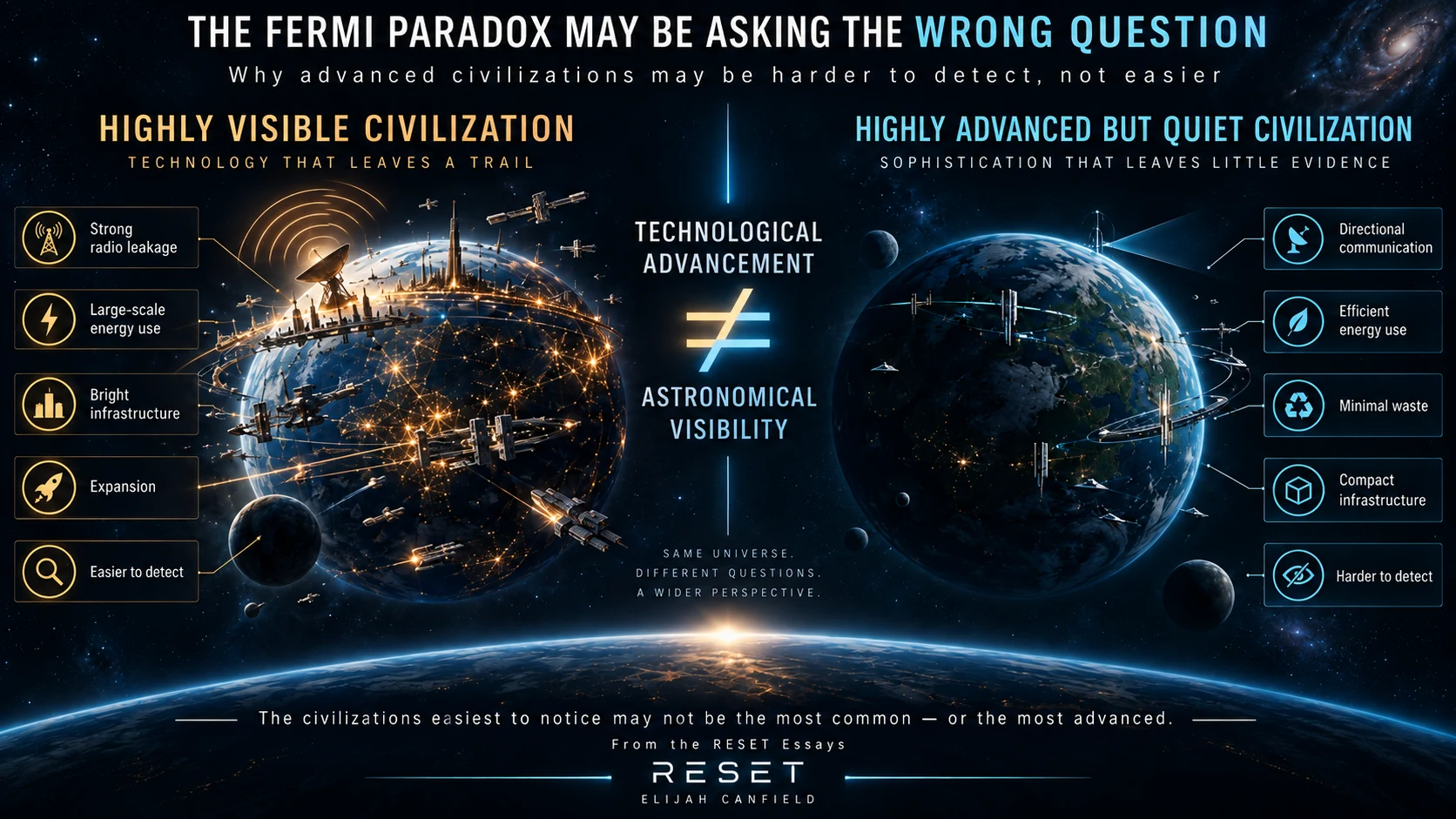
Technological sophistication and astronomical visibility are not necessarily the same thing.
They may even move in opposite directions.
Civilization Is Not the Same Thing as Detectability
The civilizations we can detect may be the unusual ones
This creates a strange selection effect.
Imagine two technological civilizations.
Civilization A expands aggressively.
It broadcasts powerful signals.
It consumes enormous quantities of energy.
It alters planets.
It builds large structures.
It produces massive amounts of detectable waste.
Civilization B develops equally advanced technology but becomes extraordinarily efficient.
Its population stabilizes.
Its communications are directional.
Its energy usage remains local.
Its environmental footprint shrinks.
It sends exploratory probes but has little interest in colonizing millions of worlds.
From Earth, which civilization would be easier to detect?
Obviously Civilization A.
But that does not mean civilizations like A are more common.
It only means our searches are biased toward finding them.
This is a fundamental distinction.
Detectability is not abundance.
The easiest civilizations to see may be rare precisely because the behaviors that make them visible are temporary, inefficient, dangerous, or unnecessary.
Longevity may matter more than expansion
Another important variable receives less popular attention than the number of civilizations:
How long do their detectable signatures last?
Researchers Amedeo Balbi and Milan Ćirković have argued that longevity is one of the most important factors in technosignature searches.
They make an especially interesting distinction.
The lifetime of a civilization and the lifetime of its technosignature are not necessarily the same thing.
A civilization could disappear while an artifact it created remains detectable for millions of years.
Or a civilization could survive for an extremely long time while producing a detectable signal for only a brief period.
Consider Earth.
Human civilization is ancient compared with our detectable radio history.
NASA notes that Earth has produced remotely detectable technological signatures for only a little over a century.
That century represents an almost absurdly narrow window in astronomical time.
Suppose technological civilizations commonly survive for one million years.
But suppose they produce strong, unintentional radio leakage for only their first two hundred years.
The civilization exists.
The technology exists.
The intelligence exists.
But the particular signature we know how to search for has vanished for 99.98 percent of its technological lifetime.
A silent sky would no longer be especially surprising.
We may be searching for adolescence
There is an uncomfortable interpretation of this idea.
Perhaps the technologies easiest for us to detect are not signs of advanced civilization.
Perhaps they are signs of young civilization.
- Powerful leakage.
- Rapid industrialization.
- Atmospheric pollution.
- Exponential energy consumption.
- Aggressive physical expansion.
- Waste.
These are all behaviors humanity recognizes because we currently exhibit some version of them.
We therefore imagine advanced civilizations by extending our present trajectory forward.
More energy. More territory. More transmission. More construction. More visibility.
But extrapolation is not destiny.
Human children become larger and louder for a time.
That does not mean maturity consists of becoming infinitely large and infinitely loud.
Civilizations could follow a similar curve.
Perhaps technological adolescence produces the brightest technosignatures.
Maturity may produce something else.
Survival could select against visibility
Now push the thought experiment one step further.
Suppose technological civilizations face existential risks.
- Nuclear war.
- Engineered pathogens.
- Uncontrolled artificial intelligence.
- Ecological collapse.
- Asteroid impacts.
- Social instability.
- Technologies we have not yet encountered.
The civilizations that survive for millions of years may not simply be lucky.
They may behave differently.
Perhaps long-term survival rewards restraint. Redundancy. Efficiency. Caution. Distributed infrastructure. Control of dangerous technologies. Minimal unnecessary signaling.
A civilization optimized for survival might look very different from one optimized for expansion.
There is no evidence that extraterrestrial civilizations actually behave this way.
But from an evolutionary standpoint, the possibility is worth considering.
We usually ask why an old civilization has not conquered or transformed the galaxy.
Maybe survival is exactly why it hasn’t.
The Fermi Paradox may confuse survival with expansion
This is the assumption I find most interesting.
If a civilization becomes extremely long-lived, we often imagine it spreading farther and farther simply because it has more time.
But time creates opportunity, not motivation.
A civilization that can travel between stars is not necessarily a civilization that wants to occupy every star.
Humans already possess technologies we choose not to deploy everywhere simply because doing so would provide little benefit.
Capability and behavior are different variables.
An advanced civilization could know how to construct interstellar probes without using them to colonize the galaxy.
It could understand stellar engineering without dismantling planets.
It could transmit across interstellar distances without continuously broadcasting.
It could know we exist and have no particular reason to interact with us.
The question “Why haven’t they colonized everything?” therefore tells us as much about our assumptions as it does about hypothetical aliens.
Maybe the universe is full of things we are not equipped to recognize
Technosignature science has already moved far beyond radio.
NASA describes possible signatures including radio and laser transmissions, artificial atmospheric chemicals, infrared excess associated with energy use, and giant engineered structures.
SETI researchers are considering atmospheric technosignatures, unusual optical behavior, artifacts, archival astronomical anomalies, and even microscopic engineered particles that might become preserved in lunar soil.
That expansion matters because every new search method implicitly acknowledges something:
We do not know what technological life will look like.
Radio SETI was never foolish.
Radio is physically sensible, detectable, and capable of traveling enormous distances.
But it is one possibility among many.
The more possibilities researchers consider, the less surprising it becomes that a narrow search has not yet succeeded.
Perhaps the galaxy is not silent.
Perhaps most of it is speaking in forms we have not learned to recognize.
There is another problem: timing
Distance in astronomy is also time.
If a civilization is 5,000 light-years away, we see it as it existed 5,000 years ago.
If its technological phase changes rapidly, the version we observe may bear little resemblance to what exists there now.
A civilization might produce a detectable technosignature for a thousand years and then become invisible to our instruments.
Its signal passes Earth before our species invents radio astronomy.
By the time we look, nothing remains.
Or we detect evidence from a civilization that disappeared thousands of years before humanity existed.
The Milky Way does not present itself to us in real time.
We see a patchwork of different eras.
Two civilizations can inhabit the galaxy simultaneously in a broad geological sense and still miss one another completely.
Their detectable windows may simply never overlap.
The absence of contact is not the absence of civilization
This distinction becomes essential.
There are at least four very different statements:
- We have not detected extraterrestrial intelligence.
- Extraterrestrial intelligence does not exist nearby.
- Extraterrestrial intelligence does not exist in the galaxy.
- Extraterrestrial intelligence does not exist anywhere.
Only the first statement is supported by current evidence.
NASA states plainly that no technosignature has yet been confirmed.
Everything beyond that requires assumptions about frequency, technology, behavior, duration, distance, and detectability.
The silence is real.
Its meaning is not.
So what should the Fermi Paradox ask instead?
“Where is everybody?” remains one of the best questions ever asked about humanity’s place in the universe.
But perhaps it needs a companion.
Not:
If advanced civilizations exist, why aren’t they everywhere?
But:
If advanced civilizations exist, what would make us capable of noticing them?
That question forces us to separate existence from visibility.
It makes us think about technological lifetimes.
It makes us question our assumptions about endless growth.
It asks whether efficiency could erase technosignatures.
It reminds us how little of the cosmic haystack we have actually searched.
And it forces us to consider a possibility that is somehow more unsettling than an empty universe.
Maybe intelligence is not rare.
Maybe obvious intelligence is.
The darkest possibility is not that everyone disappears
Much of the Fermi Paradox discussion eventually reaches catastrophe.
Perhaps technological civilizations destroy themselves before becoming interstellar.
It is an understandable possibility, partly because we can imagine several ways humanity might accomplish exactly that.
But there is another answer that produces the same observational result without requiring universal extinction.
Civilizations survive.
They simply stop looking like us.
Their waste disappears.
Their communications become difficult to intercept.
Their population stabilizes.
Their machines shrink.
Their infrastructure becomes less obvious.
Their activity becomes indistinguishable from natural background at interstellar distances.
Perhaps some remain in their home systems.
Perhaps some expand quietly.
Perhaps they send machines rather than biological populations.
Perhaps the longest-lived civilizations eventually learn that being visible has little value.
From Earth, extinction and extreme technological maturity could initially look exactly the same.
Silence.
And that may be the most important weakness in the way we casually describe the Fermi Paradox.
We treat silence as though it were an answer.
It is only an observation.
The question that remains
Humanity is becoming better at searching.
Radio telescope arrays can examine larger portions of the sky.
Astronomers are studying exoplanet atmospheres.
Machine-learning systems can search enormous datasets for unusual patterns, which raises its own question: how AI could recognize alien intelligence before humans do.
Researchers are expanding the concept of technosignatures beyond intentional messages to include chemistry, heat, structures, artifacts, and anomalies.
The search will improve.
But perhaps the most important improvement will be conceptual.
We need to stop assuming that extraterrestrial civilizations will resemble enlarged versions of ourselves.
The universe is not obligated to make intelligence obvious.
A civilization a million years older than humanity may not broadcast its presence.
It may not colonize every available world.
It may not require stellar-scale energy.
It may not produce pollution.
It may not build anything we recognize as a monument.
It may have learned lessons we have not yet encountered.
And if longevity rewards restraint rather than expansion, the oldest civilizations may be the hardest ones to find.
The Fermi Paradox asks:
Where is everybody?
Perhaps the better question is:
Why did we ever assume they would be easy to see?
FAQ
Frequently Asked Questions
The Fermi Paradox describes the tension between the apparent possibility of extraterrestrial technological civilizations and the fact that humanity has found no confirmed evidence of them. It is commonly summarized by Enrico Fermi’s question, “Where is everybody?”
No. The Fermi Paradox is an argument or puzzle, not proof that extraterrestrial intelligence does not exist. Its implications depend on assumptions about how frequently technological civilizations arise, how long they survive, how they behave, and how detectable they are.
No. SETI researchers have estimated that searches to date have covered only a very small fraction of the enormous multidimensional parameter space in which extraterrestrial signals might exist.
Yes, in principle. Its communications could be weak or directional, its energy use efficient, its detectable technological phase brief, or its technologies unlike the signatures we currently know how to search for.
No. Interstellar expansion is physically conceivable, but there is no scientific reason every technological civilization must choose continuous expansion. NASA research has explored scenarios in which high standards of living could be maintained without galaxy-scale growth.
The longer a technosignature remains detectable, the greater the chance that another civilization exists at the right time and place to observe it. A civilization can also survive much longer than any particular detectable technology it produces.
No. Humanity has not confirmed any extraterrestrial technosignature.
Sources & Further Reading
- The Fermi ParadoxSETI Institute
- Searching for Signs of Intelligent Life: TechnosignaturesNASA
- NASA Scientists on Why We Might Not Spot Solar Panel TechnosignaturesNASA
- Detectability of Solar Panels as a TechnosignatureKopparapu et al., The Astrophysical Journal (2024)
- Earth Detecting Earth: At What Distance Could Earth's Constellation of Technosignatures Be Detected with Present-day Technology?Sheikh et al., The Astronomical Journal (2025)
- How Much SETI Has Been Done? Finding Needles in the n-Dimensional Cosmic HaystackWright, Kanodia & Lubar, The Astronomical Journal (2018)
- Longevity Is the Key Factor in the Search for TechnosignaturesBalbi & Ćirković, The Astronomical Journal (2021)
Explore the Question Through Fiction
The Fermi Paradox helped inspire one of the central ideas behind RESET:
What if the civilizations that survive the longest are the ones that learned not to be seen?
If another civilization had survived for hundreds of thousands of years, would it really behave like a younger civilization with better technology?
Would it keep expanding? Would it announce itself?
The RESET series imagines a civilization nearly a million years ahead of humanity that has survived partly because no one knew it existed.
Discover the RESET universe
Read RESET: First Contact free.
Human artificial intelligence is beginning to notice something that has remained hidden for hundreds of thousands of years.
And the civilization watching us must decide what to do before discovery becomes inevitable.
Related Essays
12 minute read
Could AI Discover Alien Intelligence Before Humans Do?
AI is already helping scientists search for technosignatures. Could machines recognize evidence of alien intelligence before humans understand what they have found?
About the Author
Elijah Canfield
Elijah Canfield is a mechanical engineer, inventor, entrepreneur, and author of the RESET science-fiction thriller series. His writing explores artificial intelligence, first contact, hidden civilizations, technological risk, and the assumptions humanity makes about its place in the universe.